
What Can Facial Acupuncture Realistically Do for Your Skin?
Does Facial Gua Sha Really Lift and Shape Your Face
Does Facial Gua Sha Really Lift and Shape Your Face
Scroll through social media for five minutes and someone will promise that facial gua sha gives you a snatched jawline, lifted cheekbones and a slimmer face in a single sitting. The before-and-after videos look convincing.
Some of those effects are real. Others are good lighting and a puffy “before” shot. Below, we separate what facial gua sha can realistically do from the exaggerated claims, and explain what happens in a professional session.
Table of Contents
The TCM Principle Behind Facial Gua Sha
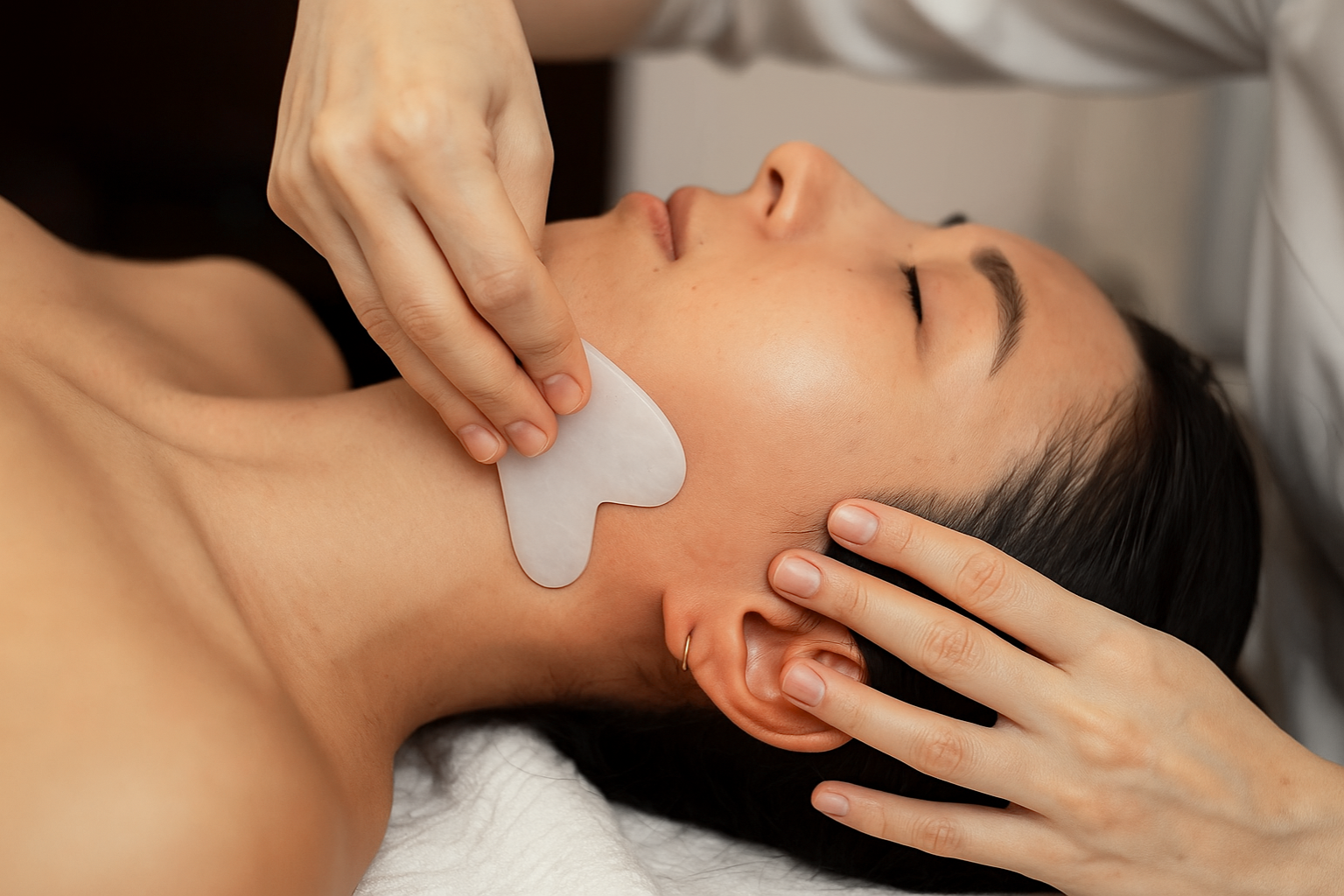
Gua sha means “scraping”. In TCM, a smooth-edged tool is glided across the skin to move stagnant qi and blood, the kind of stagnation that shows up as dullness, puffiness or tightness in the face. Modern practitioners also describe the strokes as supporting lymphatic drainage, helping fluid that collects under the skin move towards the lymph nodes in the neck.
A trained practitioner’s session differs from a home routine in a few clear ways:
- The practitioner assesses your skin and TCM constitution first and adjusts pressure and focus areas to match.
- Strokes follow a set direction and sequence across the face, jaw and neck, starting with the neck so fluid has somewhere to drain.
- Pressure is controlled, firm enough to release tight muscles around the jaw and brow, light enough to avoid bruising.
- Techniques such as BoJin work on tight fascia, something a retail tool used in front of the mirror rarely reaches.
Home tools have their place. They are simply a lighter version of the same idea.
What Facial Gua Sha Can and Cannot Do for Your Skin
Here is what you can realistically expect:
- Temporary de-puffing, often visible straight after a session
- Better circulation and a brighter, fresher-looking complexion
- Release of muscle tension in the jaw, brow and forehead
What gua sha will not do is permanently reshape bone structure or replace a surgical lift.
Research on the muscle side is encouraging. A 2025 randomised controlled trial in the Journal of Cosmetic Dermatology followed 34 women over 8 weeks and found gua sha massage clearly reduced facial muscle stiffness and tone measurements, along with small improvements in facial contour. A facial roller performed better for skin elasticity in the same trial. The sample was small and participants massaged at home five times a week, so the result reflects steady, repeated use, not a single session.
Expect results to build in stages. A brighter complexion and less puffiness can show soon after a session, though results vary from person to person. Your practitioner will suggest how many sessions you need after assessing your skin, and the effect fades if you stop completely.
What to Expect During a Facial Gua Sha Session
A professional session at our centres lasts about 50 minutes. It usually runs in this order:
- A short assessment of your skin condition and TCM constitution
- A gentle cleanse, then a facial oil so the tool glides smoothly over the skin
- Gua sha strokes across the neck, jaw, cheeks and forehead using jade or stone tools, sometimes combined with BoJin techniques
The sensation is firm but comfortable, and a lot of people find it relaxing, especially around a tight jaw. Tell your practitioner if any area feels tender.
Many people carry tension in the jaw without realising it, often from clenching at a desk or grinding at night. Once that area relaxes, the lower face can look noticeably different.
Aftercare is simple. Mild redness or flushing is normal and fades within a few hours. Your skin may be more sensitive to the sun for the rest of the day, so wear sunscreen, and skip heavy makeup and intense heat such as a sauna until the next day.
Quick Answers to Common Facial Gua Sha Questions
How often should I book a facial gua sha session?
Many people start with weekly sessions, then space them out. Your practitioner will suggest a schedule after assessing your skin.
Can an at-home gua sha tool replace a professional session?
Not fully. A home tool is useful for daily de-puffing and keeping tension down between visits. A professional session adds an assessment, controlled pressure and fascia techniques that are hard to do on yourself.
Ready to try it? Book a facial gua sha session with our practitioners and ask them to show you a simple routine to use at home.
What Face Lifting and Face Shaping Really Mean With Gua Sha
“Lifting” and “shaping” sound dramatic, but with gua sha they describe two fairly modest physical changes. Muscles that were tight and bunched, especially around the jaw, relaxed and sat more evenly, and fluid that made the face look puffy drained away. Together, those changes make the jawline and cheekbones look better defined.
A surgical facelift or dermal filler changes tissue position or adds volume. Gua sha does neither. Any lasting difference in face shape comes from consistent sessions over time, since a single treatment wears off within days.
If your main goal is a firmer contour, think of gua sha as a habit you keep up, not a procedure you book once.
Is Facial Gua Sha Worth Adding to Your Skincare Routine
Facial gua sha and gua sha face massage work best as a complementary addition to your routine, not a replacement for good skincare or medical treatment. Gua sha face lifting and gua sha face shaping results build gradually, and they reward consistency.
Xi TCM Centre offers professional Facial Gua Sha and BoJin sessions performed by TCM practitioners registered with the T&CM Council under the T&CM Act 2016 (Act 775). Book a professional facial gua sha session at Xi TCM Centre to find out which beauty gua sha techniques suit your skin, or explore our wider TCM aesthetic treatments.
This article is for general information only and does not replace advice from a registered medical practitioner.